
Taser and Stun Gun Laws in Oregon
By Michael G. Romano, Managing Attorney
Stun guns are a less-lethal type of electroshock weapon, and TASER is a brand of stun gun. It’s probably the best-known brand because so many police agencies carry it. Civilians in Oregon can also buy, own, and carry stun guns and Tasers for self-defense, but there are limits on where you can take one, and there are serious criminal consequences for using one the wrong way.
Oregon has no permit or registration requirement for stun guns. The law focuses on how you use the device, not whether you own it. The two statutes that matter most are ORS 163.212 and ORS 163.213, which make it a crime to discharge a stun gun against another person in certain circumstances. This page explains those statutes, the penalties, the places stun guns are off limits, and how Oregon self-defense law applies.
Is It Legal to Own a Taser or Stun Gun in Oregon?
Yes. No Oregon statute prohibits buying or possessing an electrical stun gun, and you don’t need a license, permit, or background check to buy one. Oregon’s background check and concealed handgun license laws apply to firearms, and a stun gun isn’t a firearm.
Federal law points the same way. In Caetano v. Massachusetts (2016), the U.S. Supreme Court unanimously vacated a Massachusetts decision that had upheld a state ban on stun guns. The Court rejected the idea that Second Amendment protection is limited to weapons that existed when the Bill of Rights was adopted.
Oregon’s own constitution adds another layer. Article I, section 27, protects the right to bear arms for self-defense, and the Oregon Supreme Court has applied it to hand-carried defensive weapons other than guns. It struck down laws banning possession of billy clubs (State v. Kessler, 1980, and State v. Blocker, 1981) and switchblades (State v. Delgado, 1984). Oregon’s appellate courts haven’t had to apply that analysis to stun guns, largely because the legislature has never tried to ban them.
Stun Guns and Tasers Under Oregon Law
People use the words interchangeably, but the devices work differently. A traditional stun gun is a contact weapon: the electrodes have to touch the person. A TASER-style device fires two wired probes from a distance, and most can also be used in contact mode, which police call a drive stun.
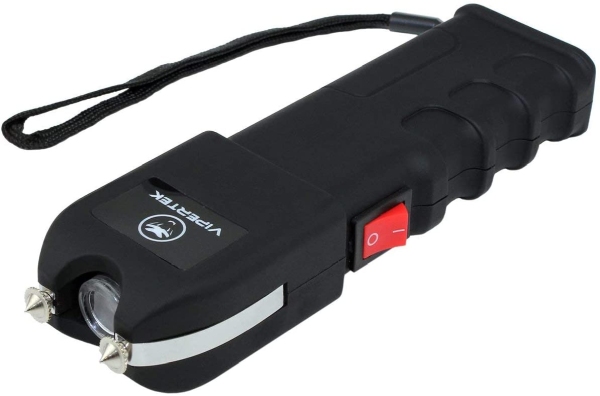
If you’re shopping for one, the VIPERTEK VTS-989 is an example of an inexpensive, rechargeable contact stun gun with a built-in LED flashlight. Whatever you buy, the legal rules on this page apply the same way. (As an Amazon Associate, Romano Law earns from qualifying purchases.)
Oregon’s criminal statutes use the phrase “electrical stun gun” without defining it. Nothing in ORS 163.211 through 163.213 distinguishes contact stun guns from probe-firing devices, so assume every electroshock device is treated the same way. The same statutes also cover tear gas, mace, and pepper spray, which is why you’ll often see those devices grouped together.
When Using a Stun Gun Is a Crime in Oregon
Unlawful Use in the Second Degree (ORS 163.212)
A person commits unlawful use of an electrical stun gun, tear gas or mace in the second degree by recklessly discharging a stun gun against another person. It’s a Class A misdemeanor. The key word is recklessly. The state doesn’t have to prove you meant to hurt anyone, only that you were aware of and consciously disregarded a substantial and unjustifiable risk (ORS 161.085). A lawful act of self-defense isn’t a crime, as explained below.
Unlawful Use in the First Degree (ORS 163.213)
The charge becomes a Class C felony when a person knowingly discharges a stun gun against someone they know is a peace officer, corrections officer, parole and probation officer, firefighter, or emergency medical services provider, while that person is acting in the course of official duty. Oregon’s sentencing guidelines rank this offense at Crime Category 6 (OAR 213-017-0006).
Other Charges That Often Come With It
Prosecutors rarely file a stun gun charge by itself. Depending on the facts, you may also face:
- Unlawful use of a weapon (ORS 166.220), a Class C felony that covers attempting to use, or carrying with intent to use, any dangerous or deadly weapon unlawfully against another person.
- Assault charges, if the use caused physical injury.
- Menacing, if the device was displayed to put someone in fear of imminent serious physical injury.
Penalties for Unlawful Use of a Stun Gun
Second degree unlawful use is a Class A misdemeanor, punishable by up to 364 days in jail (ORS 161.615) and a fine of up to $6,250 (ORS 161.635). First degree unlawful use is a Class C felony, punishable by up to five years in prison (ORS 161.605) and a fine of up to $125,000.
Those are statutory maximums. In felony cases, the actual sentence is driven by the sentencing guidelines grid, which weighs the crime category against your criminal history, and many cases resolve for far less. A conviction for either degree still leaves a criminal record that shows up on background checks for jobs, housing, and professional licenses.
Places You Can’t Take a Stun Gun
Owning a stun gun is legal. Carrying one everywhere is not.
Public buildings. Under ORS 166.370, intentionally possessing a firearm or any other instrument used as a dangerous weapon in a public building can be charged as a Class C felony. Oregon’s definition of a public building (ORS 166.360) includes hospitals, schools, colleges and universities, city halls, the Capitol, the portions of buildings occupied by state and local government agencies, and in many cases the grounds adjacent to them.
Courthouses. The same statute allows court security to require you to surrender a non-firearm weapon or remove it from a court facility. Refusing is a Class C felony. Most Oregon courthouses screen at the entrance, so leave it at home.
Airplanes. The TSA prohibits stun guns in carry-on bags. They may go in checked luggage only if packed so they can’t discharge accidentally, and batteries may have to be removed and carried separately.
Private property. Businesses and property owners can ban weapons on their premises. If you’re told to leave and don’t, you risk a criminal trespass charge.
Other states. Oregon law doesn’t travel with you. Some states and cities still restrict civilian stun guns, so check the law before you cross a state line.
Carrying a Stun Gun Concealed
Oregon’s concealed weapons statute, ORS 166.240, doesn’t mention stun guns. It makes it a Class B misdemeanor to carry concealed a switchblade, dirk, dagger, ice pick, slungshot, metal knuckles, “or any similar instrument by the use of which injury could be inflicted upon the person or property of any other person.” Whether a stun gun counts as a similar instrument isn’t clearly settled.
A concealed handgun license doesn’t solve the problem. The license covers handguns, and ORS 166.240 has no exception for license holders. The conservative approach is to carry a stun gun openly, such as in a belt holster, rather than hidden on your person.
Using a Stun Gun in Self-Defense
Using a stun gun to defend yourself or someone else can be lawful. Oregon allows physical force when you reasonably believe it’s needed to defend against the use or imminent use of unlawful physical force, and you may use the degree of force you reasonably believe is necessary (ORS 161.209). The unlawful use of a weapon statute also exempts people lawfully defending life or property.
The question in every case is whether your belief was reasonable and whether the force fit the threat. Stunning someone who shoved you and then walked away is a very different case from stunning an attacker who is still coming at you. After any use of force, expect a police investigation. Be polite, identify yourself, and don’t give a detailed statement until you’ve spoken with a lawyer. For more, read our guide to self-defense law in Oregon.
Stun guns are one of several less-lethal tools Oregonians carry. We also cover whether collapsible batons are legal in Oregon, and our Oregon gun rights section covers firearms, concealed carry, and weapons law more broadly.
Frequently Asked Questions
Are Tasers legal in Oregon?
Yes. Oregon doesn’t prohibit civilians from buying, owning, or carrying a Taser or stun gun, and no permit is required. The crimes in ORS 163.212 and ORS 163.213 apply to how a stun gun is used against another person, and separate laws restrict bringing one into public buildings and court facilities.
Do I need a concealed handgun license to carry a stun gun in Oregon?
No, and a license wouldn’t help. A concealed handgun license covers handguns only. Oregon’s concealed weapons statute (ORS 166.240) doesn’t name stun guns, but it covers any similar instrument capable of causing injury, and it has no exception for license holders. Carrying a stun gun openly is the safer practice.
What is the penalty for using a stun gun on someone in Oregon?
Recklessly discharging a stun gun against another person is a Class A misdemeanor, with a maximum of 364 days in jail and a $6,250 fine. Knowingly using one on an on-duty police officer, corrections officer, parole and probation officer, firefighter, or emergency medical services provider is a Class C felony, punishable by up to five years in prison and a $125,000 fine.
Can I use a stun gun for self-defense in Oregon?
Yes, if you reasonably believe you or someone else faces the use or imminent use of unlawful physical force, and the force you use is reasonable for that threat (ORS 161.209). Whether a particular use was justified depends on the facts, and police will investigate any use of force.
Can I bring a stun gun on a plane?
Not in your carry-on. The TSA prohibits stun guns and other electroshock weapons in the cabin but allows them in checked baggage if they’re packed so they can’t discharge accidentally. Batteries may need to be removed and carried separately, and airlines can set stricter rules, so check with your carrier before you fly.
Talk to an Oregon Weapons Defense Attorney
If you’ve been charged with unlawful use of a stun gun, unlawful use of a weapon, or an assault involving a Taser, talk to a lawyer before you talk to the police. Michael Romano has over 25 years of Oregon trial experience and began his career as a prosecutor in Klamath, Coos, and Deschutes counties, so he knows how the state builds these cases. Call 503-208-5529 or schedule a consultation.
Last updated: September 27, 2026 | Reviewed by Michael G. Romano, Managing Attorney. This page provides general information about Oregon law, not legal advice for your specific situation.